
In the design of high-torque transmission systems—ranging from industrial gear reducers(For complete gearbox assemblies, we also provide Seamless Rolled Ring Forging for high-performance gear blanks that complement our forged shafts.) and mining crushers to wind turbine main drives—the stepped shaft is a ubiquitous but critical component. While its geometry is dictated by the need to seat bearings, gears, and couplings, its structural integrity is governed by metallurgy.
For engineers at the OEM level, the primary failure mode of heavy-duty shafts is not simple yielding, but fatigue fracture, typically originating at the shaft shoulder or transition fillets. These areas are inherent stress concentrators. This technical white paper examines why the manufacturing route—specifically the transition from raw ingot to a forged stepped profile—is the single most important factor in determining the L10 life of the transmission assembly.
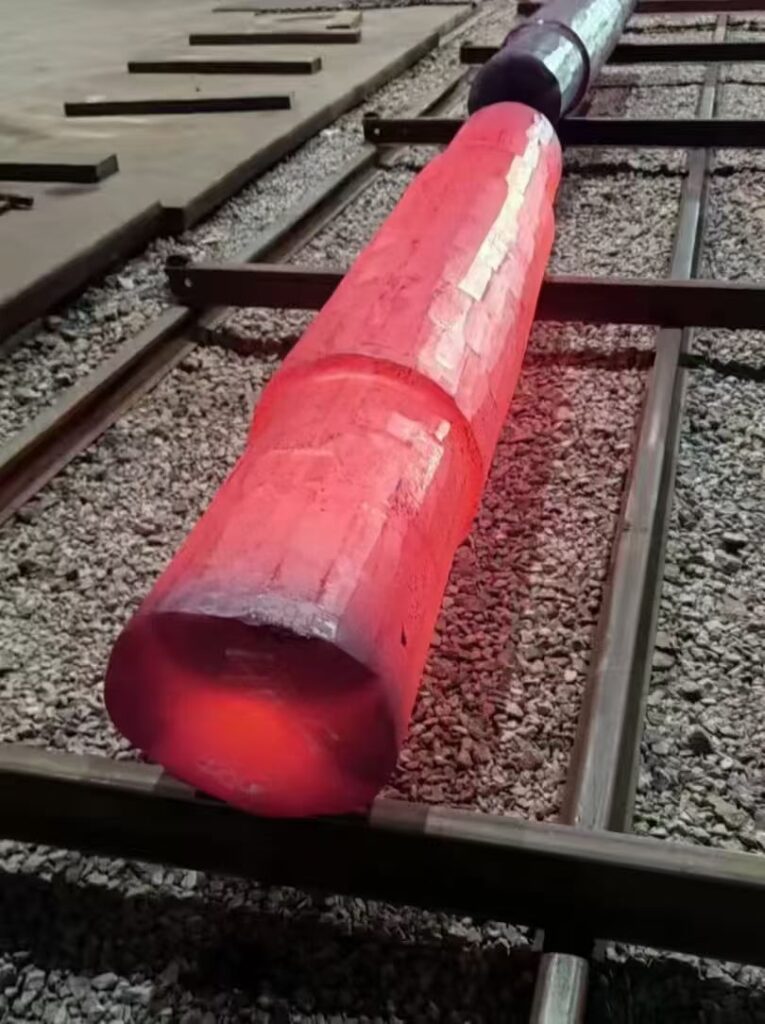
1. The Engineering Problem: Stress Concentration vs. Grain Flow
In a heavy-duty transmission shaft, the transition between diameters (the “step”) creates a localized increase in stress. Under alternating torsional and bending loads, any discontinuity in the material’s internal structure acts as a precursor to crack initiation.
The Answer-First Conclusion:
The traditional method of machining a stepped shaft from a large-diameter rolled bar is fundamentally flawed for heavy-duty applications. Machining “cuts” through the longitudinal grain flow of the steel, exposing “end grains” at the critical fillet radius. Conversely, Open Die Forging , utilizing a strategic “Drawing and Stepping” process, ensures that the metallic grain flow remains continuous and follows the external contour of the shaft. This metallurgical continuity provides a 20-30% increase in fatigue limit compared to machined bar stock.
2. Technical Deep-Dive: The Forging Process of Stepped Shafts
At Yansen Forging, the production of a heavy-duty stepped shaft follows a rigorous thermomechanical path designed to refine the dendritic structure of the initial casting.
2.1 Ingot Coring and Upsetting (Eliminating Center Porosity)
The process begins with a vacuum-degassed (VD/VOD) ingot. To ensure the core of a large-diameter shaft is sound, we employ a high-reduction Upsetting process. By compressing the ingot along its longitudinal axis, we collapse internal shrinkage porosities and break up primary alloy segregations. A minimum forging ratio of 3:1 is maintained to transform the as-cast coarse grains into a refined, wrought structure.
2.2 Drawing Out and Sectional Stepping (V-Die Technology)
The transition from a uniform cylinder to a stepped profile is where technical expertise is paramount. We utilize V-shaped dies rather than flat dies for the drawing-out process. V-dies exert tri-axial compressive stress on the workpiece, which prevents the “Mannesmann Effect” (the tendency for the center of the shaft to rupture under secondary tensile stresses during rotation).
During the Stepping Process , the forge master uses narrow forging tools to “set down” the shoulders at precise temperatures (typically between 1200°C and 850°C). This is not merely a shape-changing operation; it is a grain-alignment operation. By forging the steps to near-net shape, we ensure that the “fiber” of the steel flows around the radius of the shoulder, creating a natural reinforcement against crack propagation.
2.3 Machining Allowance and Grain Flow Integrity
A common mistake in procurement is requesting a forging that is too close to the final dimensions without considering the “Grain Flow Cut-off.” At Yansen, we scientifically calculate the Machining Allowance. If the allowance is too deep, the subsequent CNC turning will sever the optimized grain lines. We design the forging profile such that the final finish-machining only removes the decarburized layer and surface scale, leaving the densest, most aligned grain structure exactly where the highest stresses occur—at the outer 10% of the shaft diameter.

3. Material Metallurgy: Selecting the Right Alloy for Torsion and Impact
The choice of alloy determines the shaft’s response to the Quenching and Tempering (Q+T) cycle.
3.1 42CrMo4 / AISI 4140: The General Purpose Workhorse
For standard industrial gearboxes, 42CrMo4 provides an excellent balance of strength and ductility. Its Chromium and Molybdenum content ensures high fatigue resistance. However, for shafts exceeding 300mm in diameter, the “Mass Effect” becomes a concern, as the core hardness may drop significantly compared to the surface.
3.2 34CrNiMo6 / AISI 4340: The Heavy-Duty Standard
For wind power main shafts or heavy mining drives, 34CrNiMo6 is mandatory. The addition of 1.30%–1.70% Nickel (Ni) serves two critical functions:
- Deep Hardenability: It allows for a uniform martensitic transformation even in shafts with diameters exceeding 600mm.
- Low-Temperature Toughness: It ensures the shaft remains ductile in sub-zero environments (e.g., offshore wind or Arctic mining), maintaining high Charpy V-notch impact values (typically >45J at -40°C).
4. Critical Thermal Processing: Hardness Gradient Control
The geometric complexity of a stepped shaft creates a thermal nightmare during heat treatment. The “thin” sections (smaller diameters) cool much faster than the “thick” sections (larger diameters) during quenching.
4.1 Differential Quenching and Tempering (Q+T)
To prevent quench cracking at the shoulders and to ensure a uniform Hardness Gradient, Yansen Forging employs vertical quenching for long shafts to minimize distortion. We monitor the cooling rate to ensure that the transition from austenite to martensite is synchronized across the different diameters as much as possible.
4.2 Stress Relieving (SR)
Following rough machining, a Stress Relieving cycle is performed. This is critical for stepped shafts because the machining of different diameters releases residual stresses unevenly. Without a proper SR cycle (typically at 30-50°C below the tempering temperature), the shaft will undergo “bowing” or dimensional instability during final precision grinding or when it is put into service.
5. Absolute Quality Assurance: The NDT Gatekeeping
For critical transmission components, visual inspection is irrelevant. We rely on Non-Destructive Testing (NDT) to validate the internal integrity.
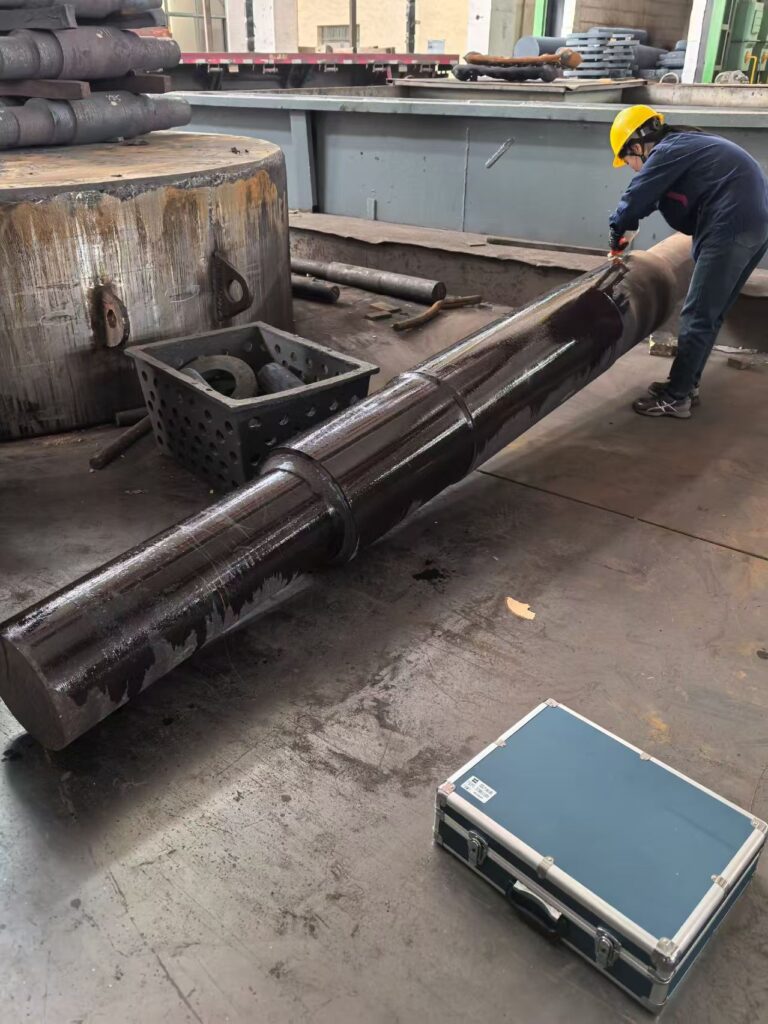
5.1 Ultrasonic Testing (UT) per EN 10228-3 / ASTM A388
This is the “gold standard” for forged shafts. We perform UT at two stages: after forging and after Q+T.
- The Challenge: The steps (shoulders) create “dead zones” where ultrasonic waves reflect off the geometry rather than internal defects.
- The Solution: Our Level II/III technicians use specialized angle-beam probes to scan the shoulder regions, ensuring Class 3 or Class 4 compliance (zero indications of hydrogen flakes, pipe, or major inclusions).
5.2 Magnetic Particle Testing (MT) per EN 10228-1
While UT finds internal flaws, MT is used to find surface and near-surface discontinuities. We pay 100% attention to the fillet radii. Any “lap” or “seam” created during the forging of the step must be identified and removed, as these are the primary sites for fatigue failure.
6. Summary Decision Table: Forged Stepped Shafts vs. Machined Bar Stock
| Feature | Forged Stepped Shaft (Yansen) | Machined from Rolled Bar | Engineering Impact |
| Grain Flow Integrity | Continuous, follows shaft contour | Severed at every diameter change | Forging increases fatigue life by 20%+ |
| Center Soundness | Guaranteed by Upsetting (3:1 ratio) | Risk of residual center porosity | Prevents catastrophic centerline failure |
| Hardness Uniformity | Optimized by controlled Q+T mass effect | Variable depending on bar diameter | Consistent torque transmission capacity |
| Material Yield | Near-net shape (High efficiency) | High waste (Turning down large bar) | Forging is more cost-effective for large steps |
| NDT Reliability | 100% UT/MT compliant to EN 10228 | Surface-only inspection often used | Forging offers higher safety factors |
7. Conclusion & Engineering CTA
In the world of heavy-duty transmission, the shaft is the single point of failure that can take down an entire production line or wind farm. Specifying a Forged Stepped Shaft is not a luxury; it is a fundamental requirement for risk mitigation. By controlling the grain flow through precision open-die forging and validating the results with rigorous NDT, Yansen Forging delivers shafts that exceed the fatigue requirements of AGMA and ISO standards.
Request a Technical Consultation:
If you are currently designing a transmission system or facing premature shaft failures in the field, submit your drawings to our engineering team. We provide a full-spectrum service:
- Metallurgical Selection (42CrMo4, 34CrNiMo6, 18CrNiMo7-6)
- Forging Simulation to optimize grain flow.
- Precision CNC Machining to microns.
- Comprehensive Certification (3.1/3.2, UT, MT, Mechanical Properties).
Explore our full range of Custom Forging Services for mining and energy sectors.
Technical Q&A: Engineering FAQ for Heavy-Duty Forged Shafts
Q1: Why is a forged stepped shaft superior to one machined from a high-quality rolled bar?
A: The fundamental difference lies in Grain Flow Integrity. When you machine a stepped shaft from a large-diameter rolled bar, the CNC tool cuts across the longitudinal grain lines (fibers) of the steel. This exposes “end grains” at the critical fillet radius of the shaft shoulder, creating a metallurgical notch that invites fatigue crack initiation. In contrast, Yansen’s open-die forging process uses a “stepping” technique that deforms the grain flow to follow the shaft’s external geometry. This results in a continuous fiber structure that significantly enhances torsional fatigue resistance and impact toughness.
Q2: How does Yansen Forging ensure center soundness in shafts with a high diameter-to-length ratio?
A: We mitigate the risk of center porosity and segregation through a strictly controlled Forging Ratio (Reduction Ratio), typically maintained at a minimum of 3:1 or 4:1. By employing an initial Upsetting stage followed by drawing out with V-shaped dies, we exert deep-seated compressive stresses that reach the core of the ingot. This process collapses any residual vacuum-casting voids and ensures that the mechanical properties at the axis of the shaft are nearly identical to those at the surface.
Q3: When should 34CrNiMo6 / AISI 4340 be specified over 42CrMo4 / AISI 4140?
A: The transition point is usually dictated by the Ruling Section (Equivalent Diameter) and the operating environment. For shafts with a diameter exceeding 300mm, 42CrMo4 often fails to achieve a uniform martensitic structure at the core during quenching (the “Mass Effect”). 34CrNiMo6, with its 1.5% Nickel content, offers superior hardenability, ensuring high yield strength throughout the entire cross-section. Furthermore, if the application involves low-temperature environments (e.g., Arctic mining or offshore wind), 34CrNiMo6 is mandatory due to its excellent Charpy V-notch impact values at -40°C.
Q4: What are the critical NDT requirements for preventing “In-Service” shaft failure?
A: For heavy-duty transmission, we recommend specifying Ultrasonic Testing (UT) per EN 10228-3 Class 3 or 4. This ensures the absence of internal “Hydrogen Flakes” or non-metallic inclusions that could act as stress raisers. Additionally, Magnetic Particle Testing (MT) per EN 10228-1 should be performed after rough machining, specifically targeting the transition fillets. Since the “step” geometry can create ultrasonic “dead zones,” our technicians use specialized angle-beam transducers to ensure 100% volumetric coverage of the high-stress shoulder regions.
Q5: How do you manage dimensional stability and prevent “bowing” in long stepped shafts?
A: Dimensional instability is usually caused by unbalanced residual stresses. We implement a mandatory Stress Relieving (SR) cycle after rough machining but prior to final grinding. By heating the shaft to approximately 30-50°C below the tempering temperature, we allow the internal stresses to redistribute. For exceptionally long shafts, we utilize Vertical Heat Treatment (quenching and tempering in a vertical furnace) to eliminate the risk of sagging or bowing under the shaft’s own weight at high temperatures.
Q6: Can Yansen Forging provide 3.2 Certification for critical projects?
A: Yes. For high-risk applications in the marine or offshore wind sectors, we provide full traceability and can coordinate with third-party inspection agencies (such as DNV, Lloyd’s Register, or ABS) to issue EN 10204 3.2 Certification. This includes witnessed material testing, NDT verification, and forging process auditing.
Metallurgy of Forged Stepped Shafts: Optimizing Heat Treatment and Hardness Gradient for Heavy-Duty Performance
In the engineering of high-capacity transmission systems—ranging from multi-megawatt wind turbine main shafts to heavy-duty…
Manufacturing Engineering of Forged Stepped Shafts: Optimizing Grain Flow for Heavy-Duty Transmission
In the design of high-torque transmission systems—ranging from industrial gear reducers(For complete gearbox assemblies, we…
Advanced Gear Blank Manufacturing: Why Seamless Forging Outperforms Casting for Heavy-Duty Power Transmission
In the demanding sectors of offshore wind energy, deep-pit mining, and maritime propulsion, the gear…
Seamless Rolled Ring Forging vs. Casting & Welding: The Ultimate Guide for Heavy Industry
In the demanding sectors of wind energy, aerospace, and heavy industrial manufacturing, the structural integrity…
Open Die Forging vs. Closed Die Forging for Large-Scale Forged Shafts: A Technical Comparison for Engineers
In the realm of heavy machinery, the structural integrity of a power-transmitting component is non-negotiable….
Forged Gear Rings: The Seamless Solution for High-Performance Gear Blanks
For procurement managers and engineers in the heavy machinery sector, the reliability of a gear…
Great content! Keep up the good work!
Pingback: Forged Shaft Heat Treatment: Optimizing Hardness & Metallurgy