
In the demanding sectors of offshore wind energy, deep-pit mining, and maritime propulsion, the gear unit is the heart of the machine. These systems are subjected to extreme torque, constant alternating shear stresses, and unpredictable shock loads. For a Technical Director or Procurement Engineer, the choice of a gear blank is not merely a line item—it is a decision that dictates the Mean Time Between Failures (MTBF) and the total lifecycle cost of the equipment.
At Yansen Forging, we have observed that the most catastrophic gear failures—such as micropitting, spalling, and root fracture—often trace back to sub-surface defects or poor grain structure in the initial blank. This technical deep dive explores why the gear forging process, specifically seamless rolled ring forging, has become the global gold standard, displacing traditional casting for high-performance applications.
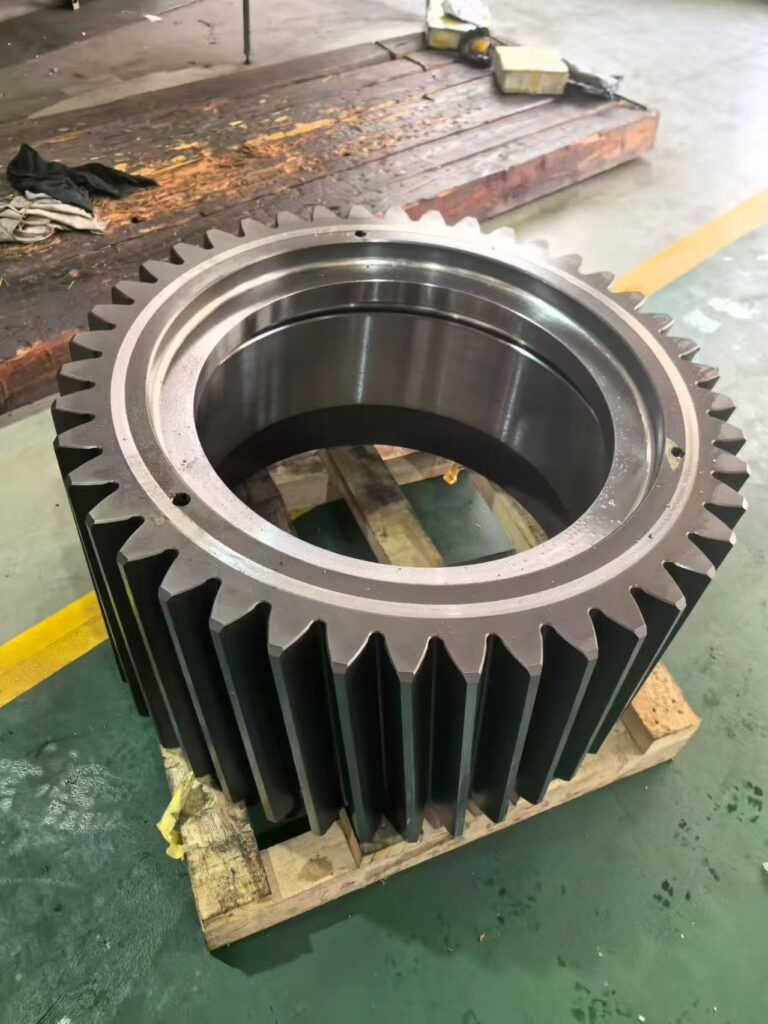
1. The Engineering Reality: Why “Good Enough” Isn’t Enough
Heavy-duty gears, such as the internal ring gears in a 10MW wind turbine gearbox or the girth gears in a ball mill, operate under Hertzian contact stresses that can exceed 1,500 MPa. In these environments, any internal discontinuity—be it a gas pore, a slag inclusion, or shrinkage porosity—acts as a stress riser.
While casting offers geometric flexibility, it inherently suffers from a dendritic, non-directional grain structure. In contrast, forged gear blanks undergo massive plastic deformation, which refines the crystalline structure and eliminates internal voids. The result is a component with significantly higher fracture toughness and fatigue resistance.
2. The Yansen Gear Forging Process: A Step-by-Step Technical Breakdown
Achieving a high-performance gear blank requires more than just heat and pressure. It requires a controlled metallurgical evolution. At Yansen Forging, our process is aligned with ISO 9001:2015 and AS9100 principles to ensure repeatability.
Phase I: Material Selection and Inclusion Control
The integrity of a gear starts with the chemistry of the melt. For heavy-duty applications, we primarily utilize high-hardenability alloy steels:
- 18CrNiMo7-6 (1.6587): The industry standard for wind power. It offers exceptional core toughness and case-hardenability.
- 42CrMo4 (4140): Preferred for high-strength structural gears requiring excellent fatigue life.
- 20CrMnTi: Widely used in heavy truck and construction machinery for its balance of wear resistance and cost.
We mandate “Clean Steel” practices, focusing on low Sulfur (S ≤ 0.010%) and Phosphorus (P ≤ 0.015%) levels to prevent hydrogen-induced cracking and improve impact strength at sub-zero temperatures (essential for Arctic wind farms).
Phase II: Upsetting and Punching (The Foundation of Density)
The process begins with an ingot or billet heated to the forging temperature (typically 1,150°C to 1,250°C).
- Upsetting: The heated steel is compressed axially on a hydraulic press. This stage is critical for breaking up the primary dendritic structure of the ingot and closing any central porosity.
- Punching: A center hole is pierced through the upset “pancake.” Unlike drilling, punching displaces the metal, further densifying the material around the bore where the gear hub will eventually reside.
Phase III: Seamless Ring Rolling (Radial-Axial Transformation)
This is where the gear forging process reaches its peak technical sophistication. The punched blank is placed onto a Ring Rolling Machine.
- The Mechanism: A mandrel (inner roll) and a main roll (outer roll) apply radial pressure, while two conical rolls apply axial pressure.
- The Result: The ring’s diameter increases while its cross-section decreases. This simultaneous two-axis compression ensures that the metal is worked thoroughly from all sides. Yansen Forging can produce seamless rings up to 8,000mm (8 meters) in diameter, maintaining tight tolerances that reduce subsequent machining time.
3. Metallurgical Advantage: The Power of Circumferential Grain Flow
The single most important reason to choose forged gear blanks over castings or bar-cut blanks is Grain Flow Alignment.
During the seamless ring rolling process, the metal’s “fibers” (the direction of elongated grains and inclusions) are oriented in a circumferential (tangential) direction.
Why does this matter for a gear?
- Bending Stress Resistance: When a gear is in operation, the highest stress occurs at the tooth root. If the grain flow is random (as in casting) or perpendicular to the tooth (as in some plate-cut blanks), the stress can easily propagate cracks along the grain boundaries.
- Tangential Strength: Because the grain flow in a rolled ring follows the contour of the gear, the teeth are cut parallel to the grain. This provides maximum resistance to the bending fatigue that causes tooth breakage.
- Impact Toughness: Forged structures exhibit up to 30-40% higher Charpy V-notch impact values compared to cast structures of the same chemical composition.
4. Heat Treatment and Precision Conditioning
A gear blank is not “finished” until its microstructure is stabilized for the gear cutter. Yansen Forging employs rigorous thermal cycles:
- Normalizing & Isothermal Annealing: To ensure a uniform pearlitic-ferritic structure, which is essential for consistent machinability and to minimize distortion during the final case-hardening (carburizing) process.
- Quenching & Tempering (Q&T): For gears requiring high core strength, we perform Q&T to achieve a tempered martensite structure, typically targeting hardness ranges specified by AGMA (American Gear Manufacturers Association) standards.
5. Quality Assurance: Non-Destructive Testing (NDT) Standards
To guarantee that every gear blank can withstand decades of service, we adhere to the strictest international inspection protocols:
- Ultrasonic Testing (UT): Conducted per EN 10228-3 or ASTM A388. We utilize multi-angle probes to ensure the blank is free of internal ruptures, “white spots” (hydrogen flakes), or non-metallic inclusions.
- Magnetic Particle Testing (MT): Conducted per EN 10228-1. This identifies any surface or near-surface discontinuities that could act as crack initiators during the gear hobbing or grinding stages.
- Spectral Analysis: Every heat is verified via OES (Optical Emission Spectroscopy) to ensure the alloying elements are within the ±0.02% tolerance required for predictable heat treat response.
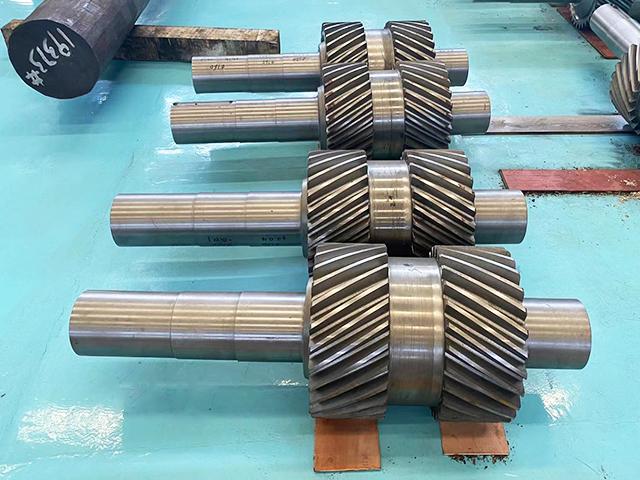
6. Technical Comparison: Forged vs. Cast Gear Blanks
| Feature | Forged Gear Blanks (Seamless Rolled) | Cast Gear Blanks |
| Internal Structure | Dense, wrought structure; zero porosity. | Potential for gas holes and shrinkage. |
| Grain Flow | Circumferential (follows gear contour). | Random/Dendritic (no flow). |
| Tensile Strength | 15-25% higher than casting. | Lower due to casting voids. |
| Fatigue Life | Exceptional; high resistance to root stress. | Moderate; prone to premature pitting. |
| Machining Allowance | Minimal (near-net shape possible). | High (to remove surface “skin” defects). |
| NDT Reliability | High (homogeneous material). | Lower (complex grain structures interfere with UT). |
7. Conclusion: The Strategic Value of Quality Blanks
For engineers designing the next generation of high-torque drivetrains, the gear blank is the foundation of the entire system’s reliability. While the initial acquisition cost of a forged gear blank may be higher than a casting, the “Total Cost of Ownership” is significantly lower. Reduced machining scrap, eliminated “surprises” during gear cutting, and the prevention of catastrophic field failures make forging the only logical choice for heavy-duty applications.
At Yansen Forging, we combine 20 years of metallurgical expertise with state-of-the-art ring rolling technology to deliver blanks that exceed AGMA 6013-B16 and ISO 6336 requirements.
Are you designing a large-scale drive system?
Contact our technical team today to discuss your material specifications and tolerances. Send your drawings to our engineering department for a comprehensive forging feasibility study.
Contact Yansen Forging Engineering Team
Metallurgy of Forged Stepped Shafts: Optimizing Heat Treatment and Hardness Gradient for Heavy-Duty Performance
In the engineering of high-capacity transmission systems—ranging from multi-megawatt wind turbine main shafts to heavy-duty…
Manufacturing Engineering of Forged Stepped Shafts: Optimizing Grain Flow for Heavy-Duty Transmission
In the design of high-torque transmission systems—ranging from industrial gear reducers(For complete gearbox assemblies, we…
Advanced Gear Blank Manufacturing: Why Seamless Forging Outperforms Casting for Heavy-Duty Power Transmission
In the demanding sectors of offshore wind energy, deep-pit mining, and maritime propulsion, the gear…
Seamless Rolled Ring Forging vs. Casting & Welding: The Ultimate Guide for Heavy Industry
In the demanding sectors of wind energy, aerospace, and heavy industrial manufacturing, the structural integrity…
Open Die Forging vs. Closed Die Forging for Large-Scale Forged Shafts: A Technical Comparison for Engineers
In the realm of heavy machinery, the structural integrity of a power-transmitting component is non-negotiable….
Forged Gear Rings: The Seamless Solution for High-Performance Gear Blanks
For procurement managers and engineers in the heavy machinery sector, the reliability of a gear…