
In sectors like wind energy, aerospace, and heavy mining, component failure is catastrophic. When engineers need circular components that can withstand extreme pressure, torque, and thermal shock, they don’t turn to welded parts or flame-cut plates. They turn to seamless rolled ring forging.
This process is the gold standard for manufacturing high-strength rings, bearings, and gear blanks. But how is a solid steel ingot transformed into a massive ring? The answer lies in a combination of open die forging pre-forming and precision ring rolling.
This guide explores the manufacturing process, the metallurgical advantages, and why this method is indispensable for heavy industry.
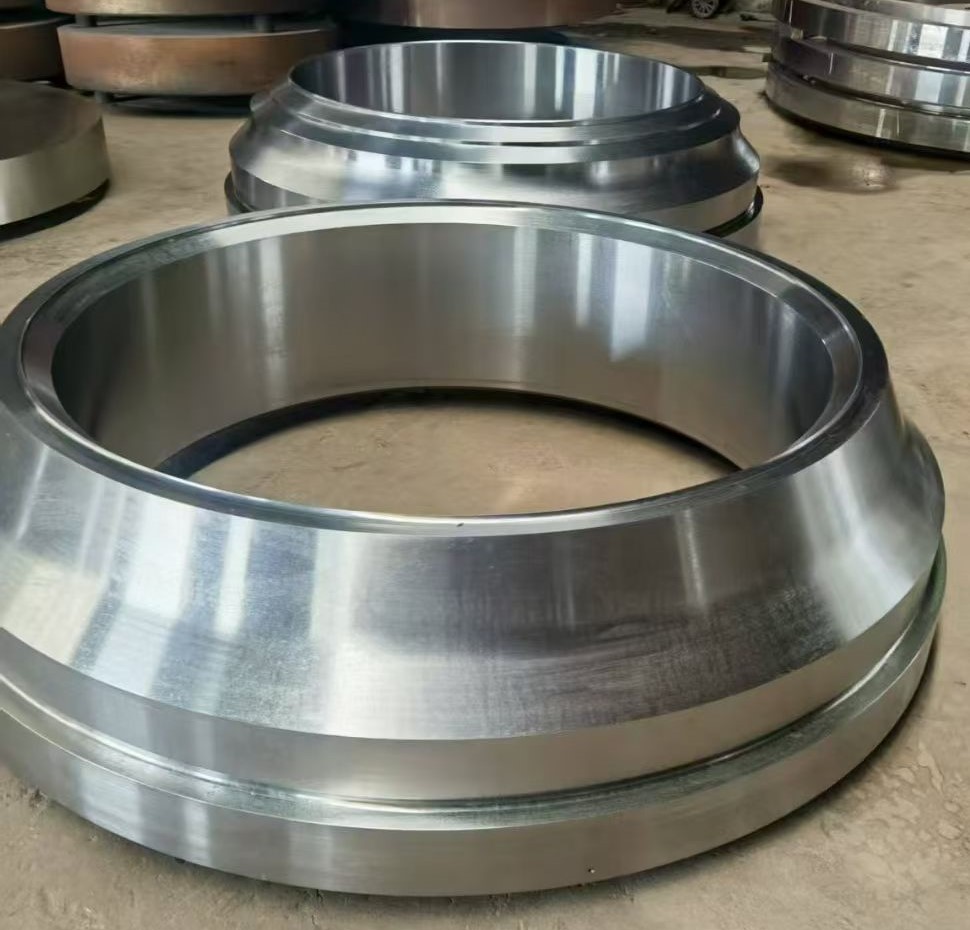
What is Seamless Rolled Ring Forging?
Seamless rolled ring forging is a metalworking process that creates a ring-shaped component from a single piece of material without any welding seams.
Unlike cutting a ring from a metal plate (which wastes material and exposes the grain ends), rolling creates a continuous, circumferential grain flow. This results in a component that is stronger, more durable, and more cost-effective for large-diameter applications.
The Process: From Open Die to Ring Mill
Producing a large seamless ring is not a single step. It is a synergy between Open Die Forging (for preparation) and Ring Rolling (for finishing).
Step 1: Billet Preparation & Heating
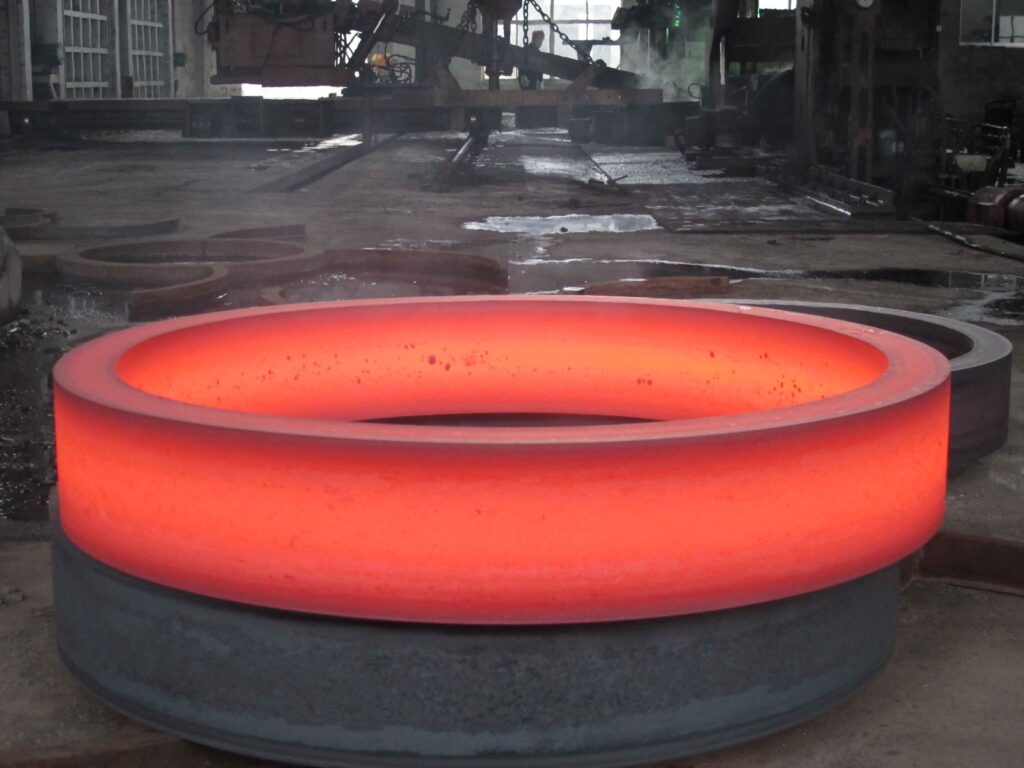
The process begins with a raw metal billet (carbon steel, alloy steel, or stainless steel). It is heated in a furnace to its plastic deformation temperature (typically 1050°C – 1200°C for steel) to ensure malleability.
Step 2: Open Die Pre-Forming (The Foundation)
Before the ring mill, the billet must be shaped using a hydraulic press. This is where Open Die Forging capabilities are crucial.
- Upsetting: The press compresses the billet to reduce height and increase diameter (pancake shape).
- Piercing: A center hole is punched through the billet to create a “donut” shape.
- Shearing: The central plug is removed.
Note: For very large rings, this open die stage determines the initial structural integrity of the workpiece.
Step 3: The Ring Rolling Operation
The pre-formed donut is transferred to the ring mill.
- The Setup: The ring revolves between a driven Main Roll and an Idler Roll (which presses from the inside).
- Deformation: As the rolls apply pressure, the wall thickness decreases, and the diameter expands. Axial cones control the height.
- Grain Alignment: The metal is not just shaped; it is kneaded. The grain structure aligns tangentially, creating superior hoop strength.
Key Advantages for Heavy Industry
Why choose seamless rolled ring forging over casting or fabrication?
- Superior Strength: The lack of seams and the directional grain flow mean the ring has uniform strength in all directions, resisting high impact and fatigue.
- Cost Efficiency: “Near-net-shape” forging closely matches the final dimensions. This significantly reduces machining time and material waste compared to cutting from a solid block.
- Versatility: We can produce rings ranging from small bearings to massive tower flanges over 5 meters in diameter.
Material Capabilities
We forge a wide spectrum of materials to meet ASME, ASTM, and ISO standards:
- Carbon Steels: SA105, A350 LF2 (for flanges and valves).
- Alloy Steels: 42CrMo4, 18CrNiMo7-6 (for heavy gears and shafts).
- Stainless Steels: 304/304L, 316/316L (for corrosion resistance).
View our full [Forging Materials List]
Applications
Our seamless rolled ring forging capabilities serve the most demanding sectors:
- Wind Energy: Tower flanges, pitch bearings, and yaw rings.
- Oil & Gas: High-pressure pipeline flanges and subsea connectors.
- Construction Machinery: Slewing rings for excavators and cranes.
- Power Transmission: Large ring gears and bull gears.
Conclusion
Seamless rolled ring forging is the backbone of heavy machinery. By combining the brute force of open die forging with the precision of ring rolling, we deliver components that ensure safety and longevity.
As a dedicated manufacturer, we control every step from the raw ingot to the final heat-treated ring. If you have a project requiring large-diameter forged rings, contact our engineering team today for a quote.
Metallurgy of Forged Stepped Shafts: Optimizing Heat Treatment and Hardness Gradient for Heavy-Duty Performance
In the engineering of high-capacity transmission systems—ranging from multi-megawatt wind turbine main shafts to heavy-duty…
Manufacturing Engineering of Forged Stepped Shafts: Optimizing Grain Flow for Heavy-Duty Transmission
In the design of high-torque transmission systems—ranging from industrial gear reducers(For complete gearbox assemblies, we…
Advanced Gear Blank Manufacturing: Why Seamless Forging Outperforms Casting for Heavy-Duty Power Transmission
In the demanding sectors of offshore wind energy, deep-pit mining, and maritime propulsion, the gear…
Seamless Rolled Ring Forging vs. Casting & Welding: The Ultimate Guide for Heavy Industry
In the demanding sectors of wind energy, aerospace, and heavy industrial manufacturing, the structural integrity…
Open Die Forging vs. Closed Die Forging for Large-Scale Forged Shafts: A Technical Comparison for Engineers
In the realm of heavy machinery, the structural integrity of a power-transmitting component is non-negotiable….
Forged Gear Rings: The Seamless Solution for High-Performance Gear Blanks
For procurement managers and engineers in the heavy machinery sector, the reliability of a gear…