
In heavy industrial applications—such as wind turbine gearboxes, mining excavators, and marine propulsion systems—gears are subjected to immense torque, shock loads, and continuous wear. To survive these extreme conditions, standard castings or machined plates are simply inadequate. Manufacturers must rely on premium forged gear materials.
However, selecting the right steel grade is only half the battle. For large-scale components, the material’s true potential is only unlocked when combined with heavy manufacturing processes like open die forging and seamless rolled ring forging.
In this comprehensive guide, we will explore the best forged gear materials used in heavy industry and how large-scale forging techniques enhance their mechanical properties.
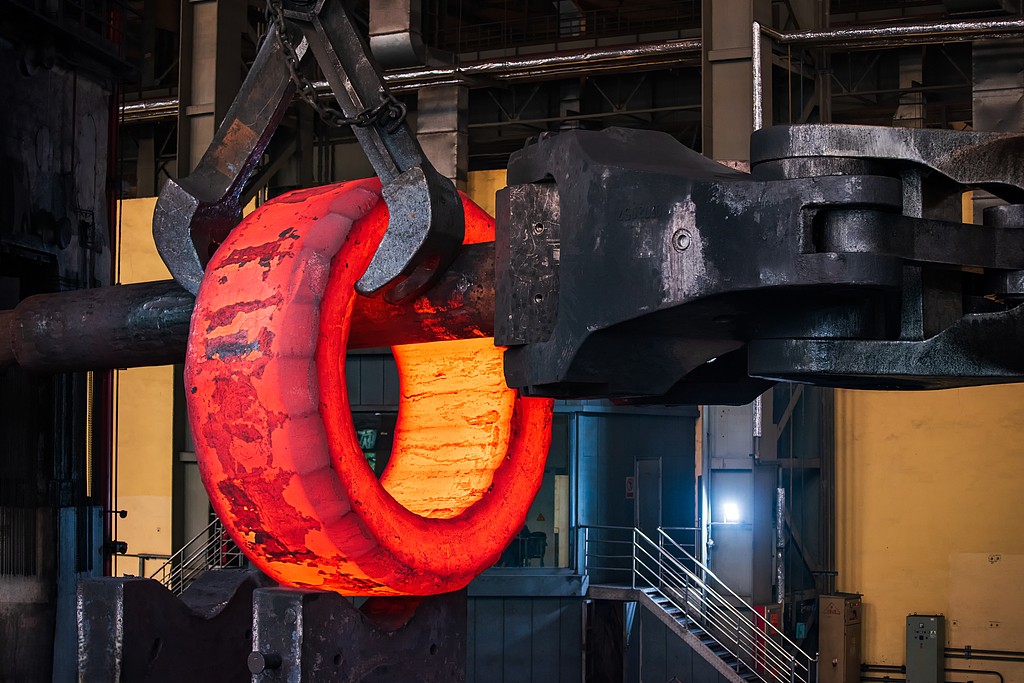
Key Requirements for Heavy-Duty Gear Materials
When engineering gears that measure several meters in diameter or weigh multiple tons, the chosen material must deliver on three critical fronts:
- High Surface Hardness: To resist wear and pitting on the gear teeth during continuous meshing.
- Excellent Core Toughness: To absorb sudden shock loads without brittle fracture.
- High Fatigue Strength: To withstand millions of rotational cycles under heavy stress.
To achieve this balance, metallurgists rely on specific alloy steels categorized by their heat-treatment response.
Top Forged Gear Materials for Large Components
For large gear blanks produced via open die or ring forging, the following steel grades are the industry standard worldwide.
1. Case-Hardening (Carburizing) Steels
These steels have a lower carbon content. After the gear is forged and teeth are cut, it undergoes carburizing to create a rock-hard surface while maintaining a ductile core.
- 18CrNiMo7-6 (1.6587): The undisputed king of heavy forged gear materials. Widely used in wind power and heavy reducers. The addition of Nickel ensures exceptional core toughness, while Chromium and Molybdenum provide deep hardenability.
- 20CrMnTi: A versatile and cost-effective carburizing steel widely used in heavy machinery and transmission gears.
- SAE 8620 / SAE 9310: Common American standard alloys used for heavy-duty drive gears.
2. Through-Hardening (Quenched & Tempered) Steels
These steels have a higher carbon content (usually 0.35% – 0.50%) and are heat-treated to achieve uniform strength throughout the cross-section. They are ideal for massive open die forged gears where deep carburizing is impractical.
- 42CrMo4 (AISI 4140): An incredibly popular high-tensile steel. It offers a great balance of strength and toughness, perfect for large girth gears and slewing rings.
- 34CrNiMo6 (AISI 4340): Offers even higher tensile strength and deep hardenability than 4140. It is specified for highly stressed, large-diameter gear blanks.
Check out our complete list of [Forging Steel Grades]
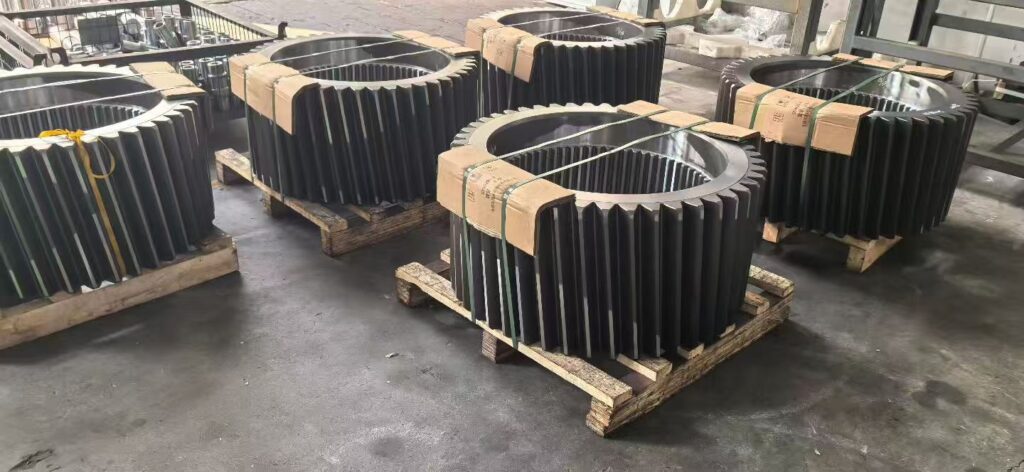
How Open Die and Ring Forging Enhance Gear Materials
You cannot produce a 3-meter ring gear using closed die forging (the molds would be impossibly large and expensive). Instead, heavy gear blanks rely on Open Die Forging and Seamless Rolled Ring Forging. Here is how these processes maximize the potential of the forged gear materials:
Open Die Forging (For Solid Pinions and Heavy Shafts)
Large ingots inherently contain internal porosity and coarse cast structures. When we forge a gear blank using a massive hydraulic open die press:
- Consolidation: The compressive force crushes internal voids, ensuring a 100% sound center (verified by UT testing).
- Grain Refinement: The severe plastic deformation refines the crystalline structure of materials like 42CrMo4, making them significantly tougher.
Seamless Rolled Ring Forging (For Ring Gears and Slewing Bearings)
For large internal or external ring gears, seamless ring rolling is the ultimate process.
- Circumferential Grain Flow: As the ring mill expands the heated donut of steel, the metal’s grain structure aligns tangentially around the circumference.
- The Benefit: This directional grain flow perfectly matches the direction of the stress the gear teeth will face, drastically reducing the chance of tooth fatigue or shear failure compared to a ring cut from a steel plate.
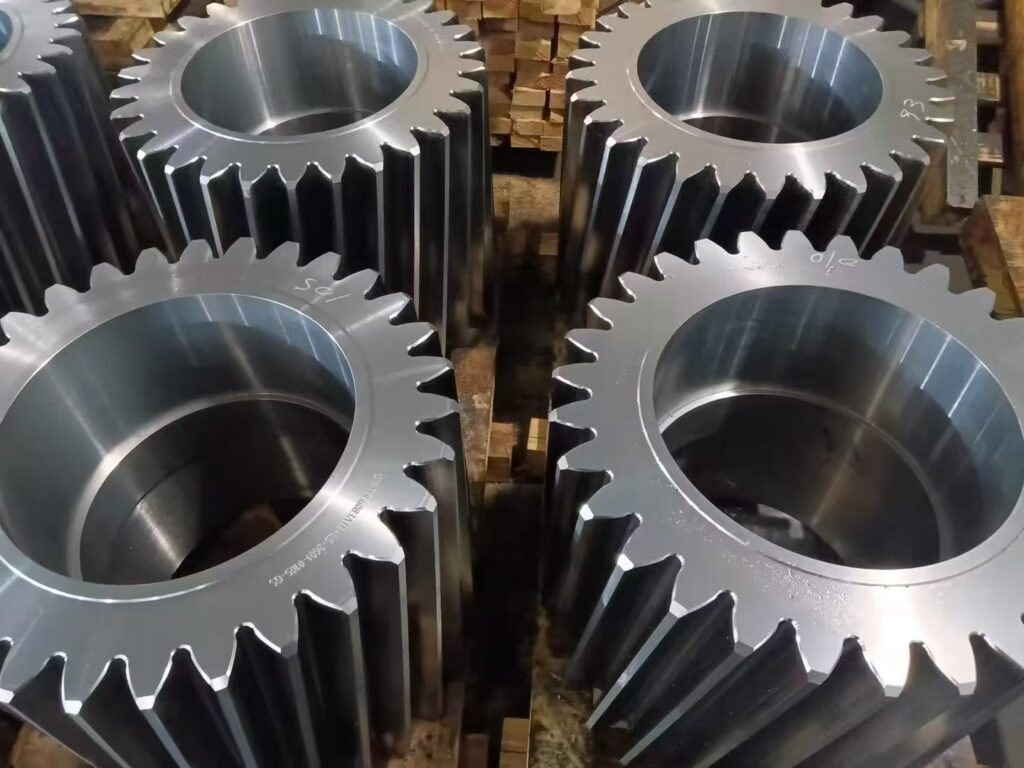
The Role of Heat Treatment
No discussion about forged gear materials is complete without mentioning heat treatment. For large open die and ring forgings, preliminary heat treatment (such as Normalizing or Isothermal Annealing) is critical immediately after forging. This relieves forging stresses and prepares the microstructure for smooth CNC machining and final gear tooth cutting.
Conclusion
Selecting the right forged gear materials—whether it is the robust 18CrNiMo7-6 for wind turbines or 42CrMo4 for mining crushers—is the foundation of reliable power transmission. However, it is the mastery of open die and rolled ring forging that truly defines the quality of the final gear blank.
If you are sourcing heavy-duty gear blanks and require a manufacturer with the capacity to forge, heat treat, and machine massive components, contact our engineering team today. We deliver precision and strength on a massive scale.
Metallurgy of Forged Stepped Shafts: Optimizing Heat Treatment and Hardness Gradient for Heavy-Duty Performance
In the engineering of high-capacity transmission systems—ranging from multi-megawatt wind turbine main shafts to heavy-duty…
Manufacturing Engineering of Forged Stepped Shafts: Optimizing Grain Flow for Heavy-Duty Transmission
In the design of high-torque transmission systems—ranging from industrial gear reducers(For complete gearbox assemblies, we…
Advanced Gear Blank Manufacturing: Why Seamless Forging Outperforms Casting for Heavy-Duty Power Transmission
In the demanding sectors of offshore wind energy, deep-pit mining, and maritime propulsion, the gear…
Seamless Rolled Ring Forging vs. Casting & Welding: The Ultimate Guide for Heavy Industry
In the demanding sectors of wind energy, aerospace, and heavy industrial manufacturing, the structural integrity…
Open Die Forging vs. Closed Die Forging for Large-Scale Forged Shafts: A Technical Comparison for Engineers
In the realm of heavy machinery, the structural integrity of a power-transmitting component is non-negotiable….
Forged Gear Rings: The Seamless Solution for High-Performance Gear Blanks
For procurement managers and engineers in the heavy machinery sector, the reliability of a gear…