
Introduction
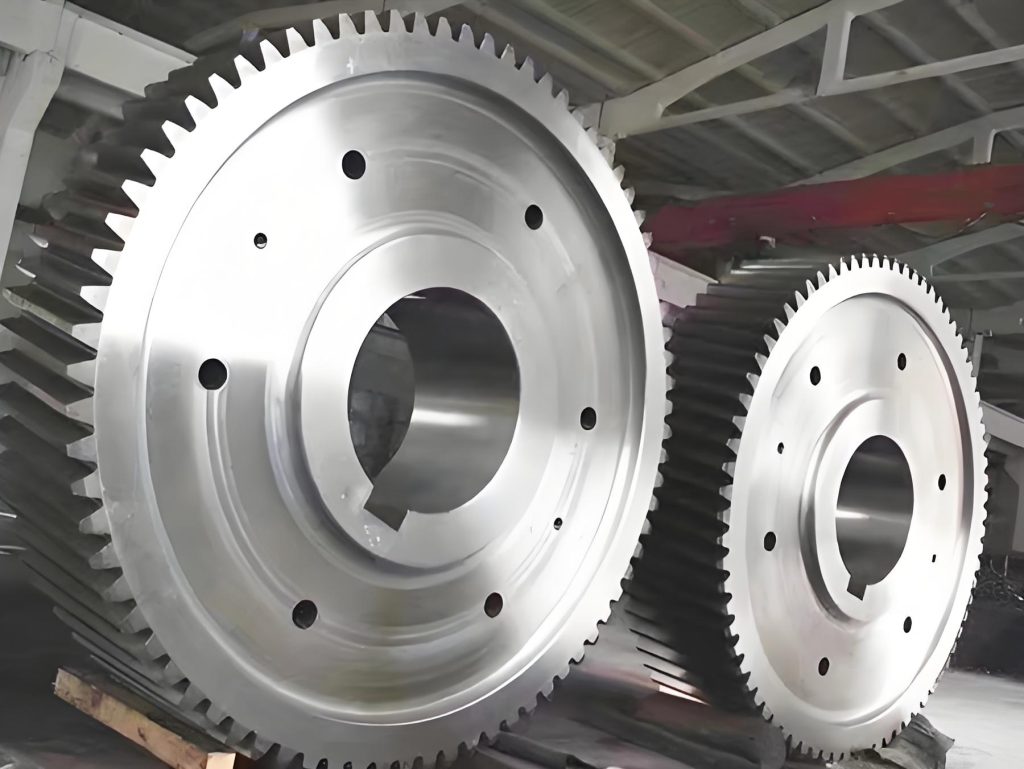
Gear rings are one of the most critical components in wind turbine gearboxes. They transfer massive torque under continuous operation, requiring high strength, durability, and precision. Forged gear rings are widely used in wind power due to their superior mechanical properties compared to cast or welded alternatives.
Why Forging is Essential for Wind Turbine Gear Rings
Forging provides a dense, uniform grain structure that improves fatigue resistance and toughness. In wind energy applications, gear rings face high loads and must resist cracks, deformation, and wear. Compared with casting, forged gear rings offer:
- Higher strength and toughness
- Better resistance to fatigue and impact
- Longer service life in harsh environments
- Fewer defects such as porosity and inclusions
Forging Process of Wind Turbine Gear Rings
The production of a forged gear ring involves several key steps:
- Material Selection – Common materials include alloy steels such as 42CrMo4, 18CrNiMo7-6, and other high-performance steels.
- Open Die Forging or Ring Rolling – Large ingots are forged and rolled into seamless rings with precise dimensions.
- Heat Treatment – Quenching and tempering ensure high hardness and toughness.
- Rough Machining – Forged blanks are machined into gear ring shape with tight tolerances.
Machining Technology for Gear Rings
After forging, precision machining is required to meet gearbox requirements:
- CNC Turning & Milling for accurate dimensions
- Gear Cutting & Hobbing to create teeth profile
- Grinding & Finishing for smooth surfaces and high accuracy
- Nondestructive Testing (UT, MT, PT) to ensure defect-free quality
These machining processes guarantee that the wind turbine gearbox gear rings can operate reliably under extreme conditions.
Applications in Wind Energy
Forged gear rings are mainly used in:
- Main Gearboxes of wind turbines
- Yaw & Pitch Drives for rotor adjustment
- High-load gear systems in renewable energy
With the growth of global wind power, demand for forged gear rings continues to rise, especially for large offshore turbines.
Advantages of Forged Gear Rings in Wind Turbine Gearboxes
- High load-bearing capacity
- Improved service life and durability
- Lower maintenance cost compared to cast rings
- Compliance with ISO, DIN, AGMA standards
FAQ – Wind Turbine Gear Ring Forging
Q1: What material is commonly used for wind turbine gear rings?
A: Alloy steels like 42CrMo4 and 18CrNiMo7-6 are widely used.
Q2: Why choose forged gear rings instead of cast ones?
A: Forged rings have higher strength, better fatigue resistance, and longer life.
Q3: What quality standards are applied in gear ring production?
A: Standards include ISO, DIN, EN10204 3.1/3.2 certification, and customer-specific requirements.
Very good written information. It will be valuable to anyone who employess it, as well as me. Keep doing what you are doing – for sure i will check out more posts.