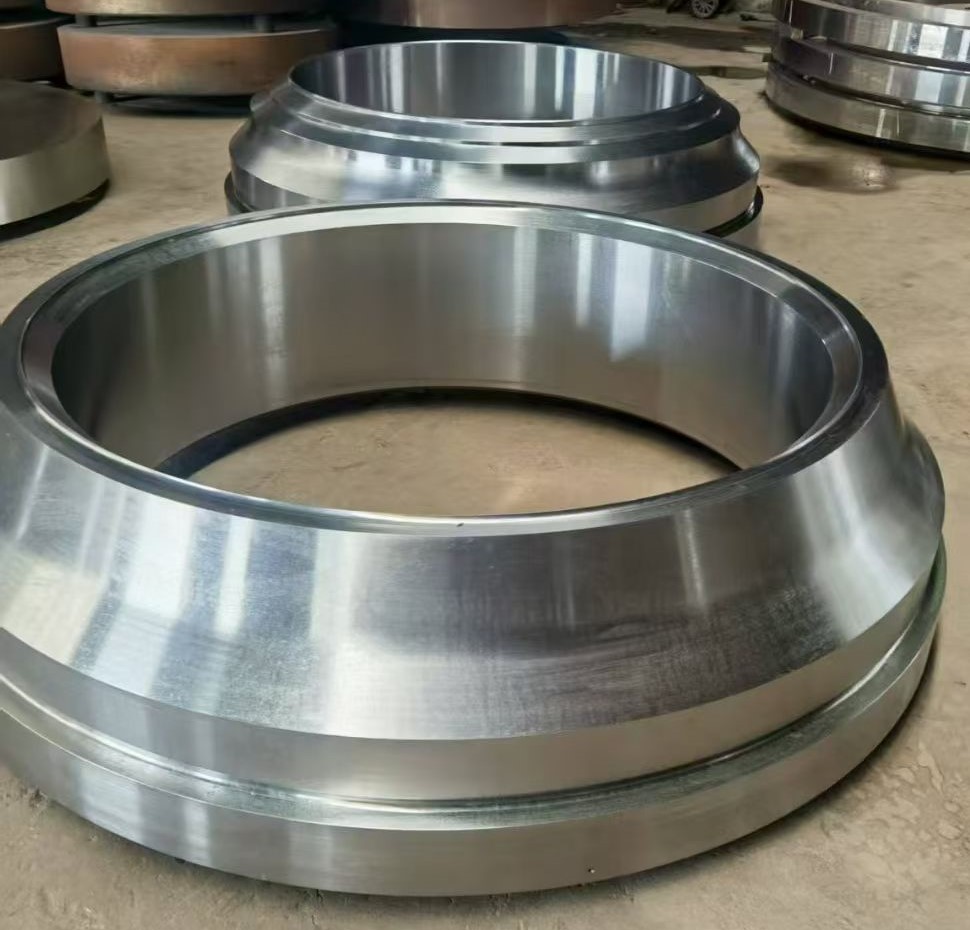
Rolled ring forgings are widely used in petrochemical, wind energy, power generation, and heavy machinery. Both stainless steel and carbon steel can be used for ring forging, but they differ significantly in terms of material properties, forging process, and application performance.
1. Material Properties
- Stainless Steel Rings
- Contain chromium, nickel, and sometimes molybdenum, offering excellent corrosion resistance.
- Maintain good strength at high temperatures.
- More resistant to oxidation and aggressive chemicals.
- Carbon Steel Rings
- Primarily composed of iron and carbon, with relatively lower alloying elements.
- Provide good mechanical strength but limited corrosion resistance.
- More suitable for general industrial applications where corrosive media are not present.
2. Forging Process Differences
- Heating Temperature
- Stainless steel requires higher and more controlled forging temperatures to avoid cracking and ensure grain refinement.
- Carbon steel can be forged more easily at lower temperatures, offering simpler process control.
- Deformation Resistance
- Stainless steel exhibits higher deformation resistance, demanding larger forging loads.
- Carbon steel has better plasticity, making it easier to shape.
- Heat Treatment
- Stainless steel rings often undergo solution treatment and passivation to enhance corrosion resistance.
- Carbon steel rings typically require normalizing or quenching & tempering to achieve desired mechanical properties.
3. Application Fields
- Stainless Steel Rolled Rings
- Used in petrochemical plants, marine environments, chemical reactors, wind energy turbines, and other fields requiring corrosion resistance and long service life.
- Carbon Steel Rolled Rings
- Commonly applied in heavy machinery, power generation equipment, gear rings, and general engineering where high strength is needed but corrosion exposure is limited.
Conclusion
Stainless steel rolled rings provide superior corrosion resistance and durability, making them ideal for demanding environments. Carbon steel rolled rings, on the other hand, offer cost-effective strength for general industrial use. Understanding these technical differences helps manufacturers and end-users select the right forging material for their specific application.