
Introduction:
In the realm of heavy industry—whether it’s the main gearbox of a wind turbine or the drive system of a mining excavator—gears are subjected to immense torque and stress. For these critical applications, standard castings or machined plates simply cannot compete. The solution lies in the gear forging process.
Specifically for large-scale components, methods like Seamless Rolled Ring Forging and Open Die Forging are the industry standards. This guide explores how these specific processes transform raw steel ingots into high-strength gear blanks ready for precision machining.
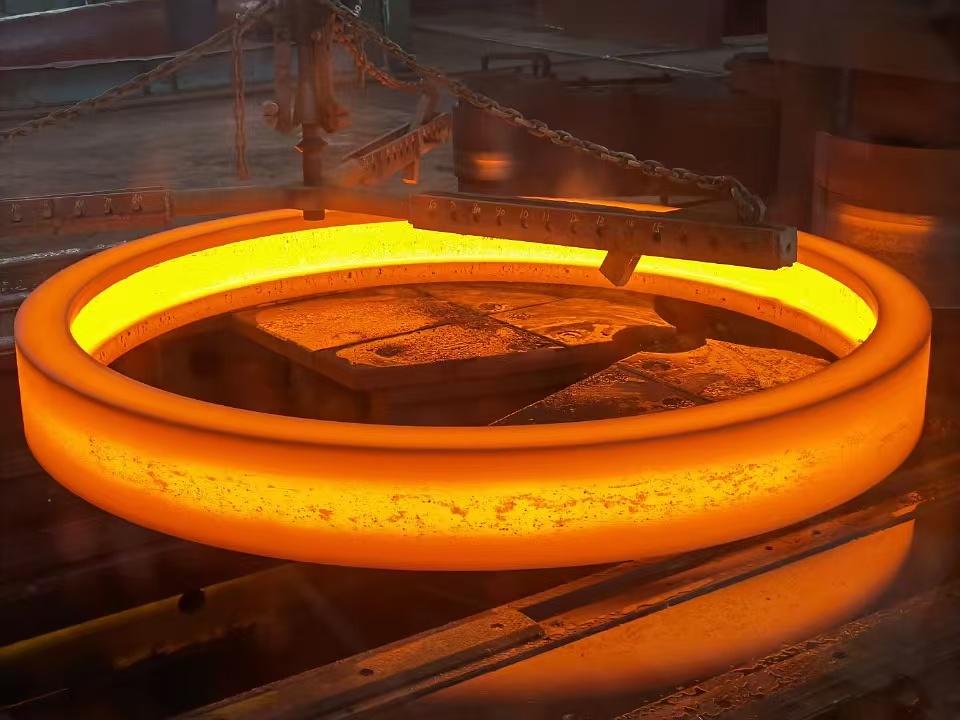
Why Forging is Essential for Large Gears
The primary goal of the gear forging process is to enhance the metallurgical properties of the steel.
- Directional Grain Flow: Unlike machining a gear from a solid block (where you cut across the grain), forging aligns the metal’s grain structure with the contour of the gear ring. This results in superior hoop strength and resistance to tooth breakage.
- Structural Integrity: Forging closes internal voids and porosity often found in castings, ensuring the gear can withstand high-cycle fatigue.
The Process: From Ingot to Gear Blank
For large gears (such as slewing rings or helical gear rims), the manufacturing process combines open die operations with ring rolling. Here is the step-by-step breakdown:
1. Billet Heating and Preparation
The process begins with cutting a high-grade steel billet (e.g., 18CrNiMo7-6 or 42CrMo4). The billet is heated in a furnace to approximately 1150°C – 1200°C to reach its plastic deformation state.
2. Upsetting and Piercing (Open Die Phase)
Before rolling, the billet must be pre-formed using an Open Die Forging press.
- Upsetting: The hydraulic press compresses the billet to reduce its height and increase its diameter (pancake shape).
- Piercing: A hole is punched through the center of the billet.
- Shearing: The remaining metal plug in the center is removed, creating a “donut” shape ready for rolling.
3. Seamless Ring Rolling
This is the heart of the gear forging process for large diameters. The pre-formed donut is placed on a Ring Rolling Mill.
- The Operation: A driver roll rotates the ring while an idler roll applies pressure from the inside. Simultaneously, axial rolls control the height.
- The Result: The wall thickness decreases, and the diameter expands to the target size (up to several meters). This continuous pressure ensures the grain flow runs circumferentially around the gear, maximizing strength.
4. Heat Treatment (Normalizing/Annealing)
After forging, the large gear blanks undergo heat treatment.
- Purpose: To relieve forging stresses and refine the grain structure.
- Benefit: This step ensures the material has a uniform hardness (typically 160-200 HB), making it easier to machine and cut gear teeth later.
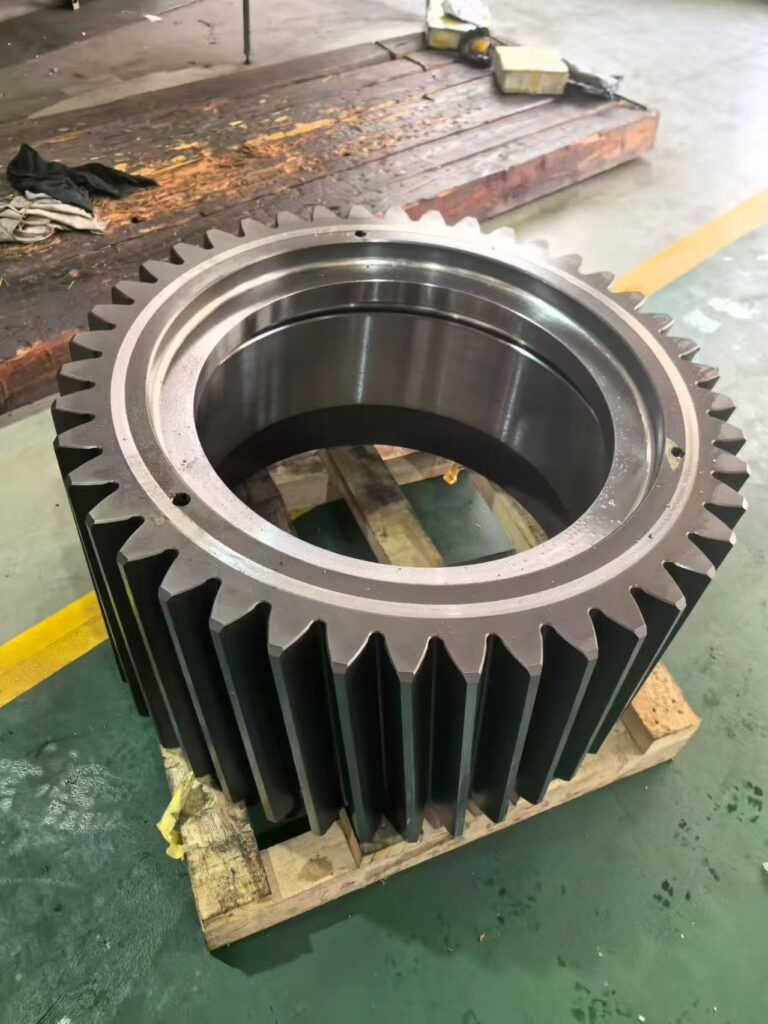
Material Selection for Heavy Gears
The success of the gear forging process also depends on the material.
- 18CrNiMo7-6 (1.6587): The top choice for heavy-duty carburized gears (e.g., wind power). It offers high core toughness and excellent surface hardenability.
- 42CrMo4 (AISI 4140): A versatile Quenched and Tempered (Q&T) steel used for medium-to-large industrial gears.
Applications of Large Forged Gears
Our capabilities in Open Die and Rolled Ring forging allow us to serve critical sectors:
- Wind Energy: Main gearbox rings and yaw drives.
- Mining Machinery: Excavator slewing bearings and ball mill girth gears.
- Marine: Ship propulsion gearbox components.
Explore our [Large Gear Blank Capabilities]
Conclusion
The gear forging process, particularly through ring rolling and open die methods, provides the foundational strength required for heavy machinery. By eliminating welds and porosity, we ensure that every gear tooth cut from our blanks can handle the load.
If you are sourcing large-diameter gear blanks or custom heavy forgings, contact our engineering team. We deliver precision, size, and metallurgical excellence.
The Ultimate Guide to Forged Gear Materials for Heavy Industry
In heavy industrial applications—such as wind turbine gearboxes, mining excavators, and marine propulsion systems—gears are…
Custom Open Die Forging: The Ultimate Solution for Heavy Industrial Components
In the world of heavy manufacturing, off-the-shelf components rarely meet the rigorous demands of critical…
Seamless Rolled Ring Forging: The Ultimate Guide to Heavy Industrial Rings
In sectors like wind energy, aerospace, and heavy mining, component failure is catastrophic. When engineers…
Titanium Forging Temperature Guide: Controlling Heat for Large Rings & Open Die Components
In the manufacturing of high-performance components, titanium is unforgiving.[1][2] Unlike steel, which allows for a relatively wide…
The Gear Forging Process: Manufacturing Large Rings and Heavy Duty Blanks
Introduction:In the realm of heavy industry—whether it’s the main gearbox of a wind turbine or…
The Titanium Forging Process: A Complete Guide to High-Performance Components
Introduction:In industries where failure is not an option—such as aerospace, medical implants, and subsea oil…