
Stainless steel forged rings are widely used in the pressure vessel industry, where safety, strength, and durability are critical requirements. Pressure vessels are designed to operate under high pressure and often in harsh environments, such as chemical plants, oil refineries, and power generation facilities. The performance of these vessels depends largely on the quality of the forged components used in their construction.
Why Choose Stainless Steel Forged Rings?
- High Strength and Durability
Forging refines the internal grain structure of stainless steel, resulting in excellent mechanical properties. This makes forged rings capable of withstanding extreme pressure and temperature without deformation or cracking. - Corrosion Resistance
Stainless steel grades such as 304, 316, 321, and 347 provide strong resistance against corrosion from chemicals, seawater, and acidic environments, which are common in pressure vessel applications. - Reliability in Critical Environments
Pressure vessels are often used in industries where failure can lead to severe consequences. Forged rings ensure consistent performance and long service life, reducing maintenance and downtime. - Custom Sizes and Precision
Forging allows for the production of large-diameter rings with precise dimensions, suitable for applications such as flanges, support rings, gaskets, and sealing components in pressure vessels.
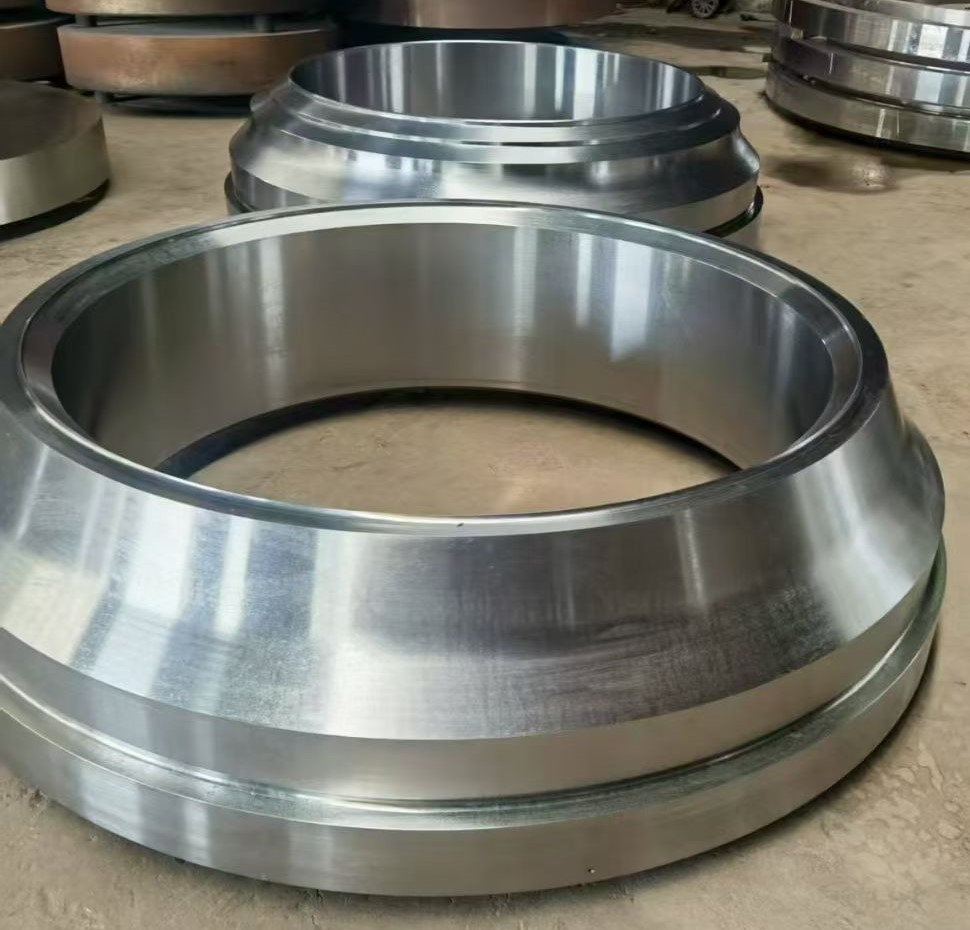
Applications in Pressure Vessels
- Flanges and Connecting Rings: Forged stainless steel rings are used to connect different sections of the pressure vessel, ensuring leak-proof performance.
- Reinforcement Rings: Provide additional strength to vessel openings and joints under pressure.
- Sealing Components: Forged rings offer tight sealing properties, preventing leakage of hazardous gases or liquids.
- Support Structures: Large stainless steel forged rings help maintain the structural integrity of heavy-duty pressure vessels.
Conclusion
Stainless steel forged rings play an essential role in the pressure vessel industry by combining superior mechanical properties with excellent corrosion resistance. Whether used in oil & gas, chemical, or power generation fields, forged rings ensure safety, durability, and performance in critical applications.
Metallurgy of Forged Stepped Shafts: Optimizing Heat Treatment and Hardness Gradient for Heavy-Duty Performance
In the engineering of high-capacity transmission systems—ranging from multi-megawatt wind turbine main shafts to heavy-duty…
Manufacturing Engineering of Forged Stepped Shafts: Optimizing Grain Flow for Heavy-Duty Transmission
In the design of high-torque transmission systems—ranging from industrial gear reducers(For complete gearbox assemblies, we…
Advanced Gear Blank Manufacturing: Why Seamless Forging Outperforms Casting for Heavy-Duty Power Transmission
In the demanding sectors of offshore wind energy, deep-pit mining, and maritime propulsion, the gear…
Seamless Rolled Ring Forging vs. Casting & Welding: The Ultimate Guide for Heavy Industry
In the demanding sectors of wind energy, aerospace, and heavy industrial manufacturing, the structural integrity…
Open Die Forging vs. Closed Die Forging for Large-Scale Forged Shafts: A Technical Comparison for Engineers
In the realm of heavy machinery, the structural integrity of a power-transmitting component is non-negotiable….
Forged Gear Rings: The Seamless Solution for High-Performance Gear Blanks
For procurement managers and engineers in the heavy machinery sector, the reliability of a gear…